

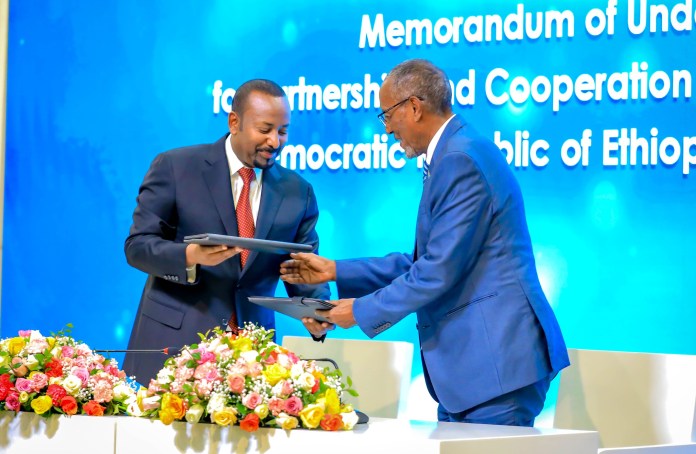

ADDIS ABABA, Ethiopia — Ethiopia’s Prime Minister Abiy Ahmed has quietly deleted social-media posts that once trumpeted a controversial memorandum of understanding (MoU) with Somaliland, removing messages in which he credited “divine intervention” for advancing Ethiopia’s dream of reaching the sea.
The disappearance of the posts, unaccompanied by any explanation, comes after a year of regional blowback and a delicate diplomatic reset with Somalia.
The original messages appeared after Abiy and former Somaliland leader Muse Bihi Abdi signed the MoU on January 1, 2024.
The deal envisioned Ethiopia leasing a 20-kilometre stretch of Somaliland’s coastline to build a naval facility and diversify its trade routes, while Addis Ababa hinted it might consider recognizing Somaliland’s independence — something no UN member state has done.
A year of tensions
Somalia reacted with fury, denouncing the pact as a blatant violation of its sovereignty. Mogadishu recalled its ambassador and warned that any port deal had to go through Somalia’s federal government, not Hargeisa.
By mid-2024, President Hassan Sheikh Mohamud was publicly declaring that his country would “never accept” an Ethiopian military base on Somaliland’s coast, even as he left the door open to commercial arrangements through direct talks.
The dispute threatened to spiral into a wider crisis, drawing in regional players. Egypt backed Somalia, while Turkey positioned itself as a mediator.
The standoff finally eased on December 12, 2024, when Abiy and Mohamud signed the Ankara Declaration, committing both countries to respect each other’s sovereignty and address Ethiopia’s maritime ambitions through dialogue and technical talks.
The accord was welcomed internationally as a breakthrough that pulled the two Horn of Africa neighbors back from the brink.
A cautious reset
In the months that followed, Ethiopia and Somalia restored diplomatic ties and launched the first round of technical talks in Ankara, aiming to balance Somalia’s territorial integrity with Ethiopia’s urgent need for alternative trade routes.
More than 90 percent of Ethiopian imports currently flow through Djibouti, leaving Addis Ababa dependent on a single corridor for its survival.
Still, key questions remain. Somalia insists that any arrangement concerning Somaliland’s coastline must come through Mogadishu, while Ethiopia frames sea access as “existential” for its 120 million citizens. The fate of the original MoU, and whether Ethiopia will pursue recognition of Somaliland, remains uncertain.
For analysts, the quiet deletion of Abiy’s posts reflects a shift in tone rather than a reversal of ambition. The triumphalist language, they argue, had become politically costly both at home and abroad.
The Ankara Declaration offers a face-saving path forward, but the underlying disputes — from sovereignty to naval access — remain unresolved and could flare again if talks falter.
For now, the Ankara process has lowered the temperature. Whether it holds will depend on whether diplomacy can deliver a compromise that respects Somalia’s borders while giving Ethiopia the sea access it has long craved — without reigniting the crisis that forced Abiy’s quiet online retreat.