

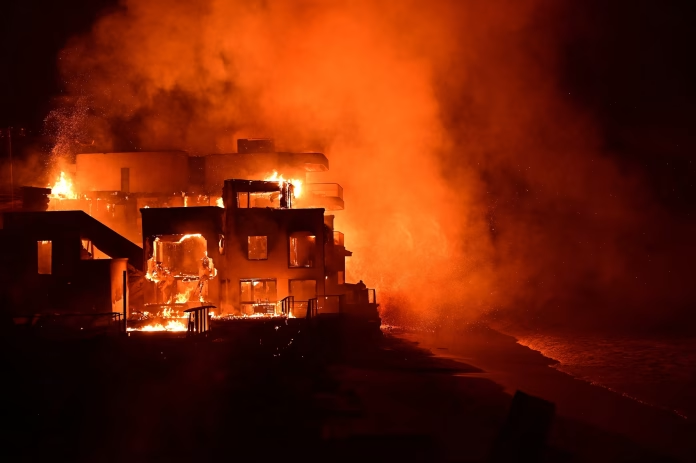

MOGADISHU, Somalia — A massive engulfed one of Mogadishu’s largest commercial hubs on Monday, killing at least three people, injuring several others, and destroying vast swaths of the Suuq Bacaad market, a vital artery of Somalia’s informal economy.
The fire broke out around 4:40 pm local time, shortly after afternoon prayers, and quickly spread through the tightly packed stalls of the market, located in the city’s Yaqshid district. Thick plumes of smoke blanketed the skyline as traders rushed to salvage what they could.
“At least three people have died,” a city emergency services official confirmed. “Two were burned alive trying to recover their goods, and one died from smoke inhalation.”
By nightfall, the fire was still raging, with emergency crews struggling to contain the blaze amid the market’s narrow alleyways and dense layout.
Ibrahim Muse, a longtime merchant at Suuq Bacaad, said his family had lost everything.
“I lost three shops, and my mother’s shops were also destroyed,” Muse told local media. “Tonight, our family has become destitute. We are in deep sorrow.”
The full extent of the damage remains unclear, but early estimates suggest millions of dollars in goods were lost, including clothing, food, electronics, and household items. Many were injured while attempting to recover inventory as the flames spread.
Emergency response overwhelmed
Firefighting crews from the Mogadishu municipality, supported by emergency teams from Hormuud Telecom and civilian volunteers, were dispatched to the scene. However, their efforts were severely hampered by the market’s congested layout and lack of modern infrastructure.
Police were also deployed to assist vendors in retrieving goods from stalls that had yet to be engulfed. Local authorities said efforts to extinguish the fire entirely were ongoing late into the evening.
The blaze underscored Somalia’s limited emergency response capacity, a legacy of decades of conflict and underinvestment. Mogadishu, a city of more than two million, has only a handful of fire trucks and poorly resourced emergency units.
Fires are frequent in Somalia’s markets, which often operate without formal regulation or basic safety standards. Overcrowded stalls, flammable goods stored in close quarters, and faulty wiring all contribute to the persistent risk.
In 2021, a fire at Mogadishu’s Bakara Market destroyed more than 200 stalls. And in 2022, the Waaheen Market in Hargeisa, Somaliland’s most significant economic hub, was devastated by a fire that caused an estimated $2 billion in losses—nearly 60 percent of the region’s GDP.
Despite repeated warnings, efforts to improve urban planning and safety infrastructure have seen little progress.
Economic shock for families
For many Somalis, markets like Suuq Bacaad are their sole source of income. The destruction of such hubs can plunge entire families into poverty overnight.
“We’re calling on the government to help the affected families,” said another vendor. “We have nothing left.”
Humanitarian agencies and local officials are expected to assess the damage in the coming days and coordinate possible relief efforts.
Over the past two decades, Suuq Bacaad has grown into one of Mogadishu’s key marketplaces, serving thousands of traders and low-income residents, including internally displaced persons (IDPs). It is the city’s second-largest market, following Bakara.
Despite its economic importance, the market has long lacked formal infrastructure. Calls from business owners for upgrades—such as regulated wiring, firebreaks, and safer storage facilities—have mainly gone unanswered due to ongoing insecurity and limited state capacity.
Authorities have launched an investigation into the cause of the fire. While an electrical fault is suspected, this has not been officially confirmed.
As of late Monday, emergency crews, police, and volunteers were still combing through the ruins, searching for salvageable goods and extinguishing lingering hot spots.