

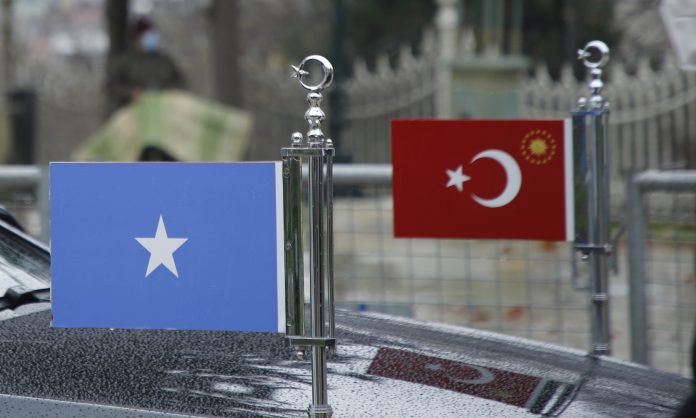

Ankara (Caasimada Online) – A heated debate in the Turkish Parliament over a land-swap agreement with Somalia has thrown a sharp spotlight on the costs and strategic ambitions of Ankara’s expansive foreign policy in the Horn of African country.
At the heart of the July 2025 parliamentary session is a deal to construct a new Somali embassy in Ankara—a move emblematic of Turkey’s deepening ties but one that has triggered pointed questions from lawmakers about transparency, cost, and the ultimate benefit to the Turkish people.
The agreement, formally titled the “Protocol on the Mutual Allocation of Plots for Diplomatic Missions,” was initially signed in 2019 but has only now come before the Foreign Affairs Committee for ratification.
Under its terms, Turkey commits not only to providing a 4,918-square-meter plot in Ankara’s prestigious Incek diplomatic enclave but also to funding and overseeing the construction of the new chancery. This gesture is framed as reciprocal to Somalia’s earlier grant of over 61,000 square meters in Mogadishu, now the site of Turkey’s largest embassy compound in the world—a facility officials describe as Ankara’s “regional diplomatic and operational hub.”
During the committee meeting, opposition lawmakers subjected the deal to intense scrutiny, particularly given the government’s recent calls for national austerity. “We are not only giving the land but also constructing the building,“ argued committee member Utku Çakırözer. “We don’t know the cost, nor do we know who will build it. Shouldn’t this be subject to stricter scrutiny?”
Concerns extended to legal safeguards. Fellow lawmaker Yunus Emre questioned what recourse Turkey would have if Somalia were to default on the agreement. In response, ministry officials assured the committee that any disputes would be resolved “amicably,“ a standard clause in such bilateral pacts.
Refik Ali Onaner, the Foreign Ministry’s director general for North and East Africa, further clarified that Turkey retains legal control over any future sale or transfer of the property, explicitly limiting its use to diplomatic functions.
A strategic gamble
Defending the initiative, government officials portrayed it not as a simple expenditure but as a crucial investment in a long-term strategic alliance. Deputy Foreign Minister Nuh Yılmaz emphasized the “special nature“ of the relationship, highlighting the deal as essential in solidifying Turkey’s role as a stabilizing power in the geostrategically critical Horn of Africa, which guards the approach to the Bab el-Mandeb Strait and the Red Sea shipping lanes.
This engagement is the centerpiece of Turkey’s broader doctrine in Africa, which combines soft power, economic investment, and security cooperation to build influence and counter regional rivals, such as the UAE and Saudi Arabia. Yılmaz drew a direct parallel to Turkey’s long-term strategy in Syria, noting that once security is established, “the field naturally opens up to Turkish businesspeople.”
This security-first model is already well-established. Turkey operates its largest overseas military facility, the Anatolia Barracks in Mogadishu, which has trained over 15,000 Somali soldiers to combat the al-Qaeda-affiliated al-Shabab insurgency. This partnership was significantly expanded in February 2024 with the signing of a landmark 10-year Defense and Economic Cooperation Framework Agreement.
The pact grants the Turkish navy authority to help secure Somalia’s vast 3,333-kilometer coastline, projecting Turkish maritime power into the Indian Ocean and providing Ankara with a significant strategic foothold.
The economic and humanitarian dimensions are equally vast. Turkey’s total aid and assistance to Somalia since 2011 has surpassed $1 billion, including a $3.5 million payment to clear Somalia’s IMF debt.
Turkish firms, such as the Albayrak Group and Favori LLC, manage Mogadishu’s strategic port and international airport, respectively. Although bilateral trade decreased from $426 million in 2023 to $384 million in 2024, proponents argue that the long-term strategic value outweighs short-term economic fluctuations.
For supporters, the relationship transcends mere geopolitics. “The reason Somalia trusts Turkey more than other countries is clear,“ declared ruling party lawmaker Derya Bakbak. “Turkey has a clean record, free from the stain of colonialism. Wherever Turkey goes, it brings justice, development, and sincerity.”