


ABU DHABI, United Arab Emirates – The United Arab Emirates is brokering high-stakes talks between Somalia’s federal government and the leaders of two powerful member states, a major diplomatic push seen as being accelerated by widening regional rivalries over the war in Sudan.
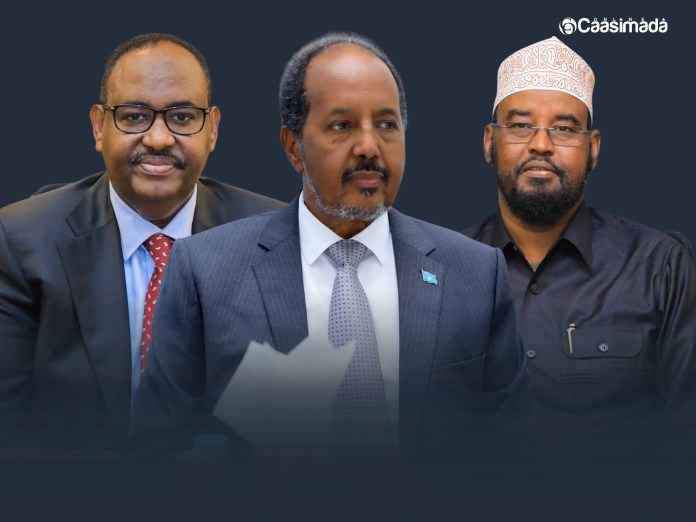
The presidents of Puntland, Said Abdullahi Deni, and Jubaland, Ahmed Madobe—two long-standing critics of the central government—are in Abu Dhabi for direct negotiations with Emirati officials, according to Caasimada Online sources.
Signaling the gravity of the talks, Somali President Hassan Sheikh Mohamud is expected to join the discussions in the UAE capital following a trip to Qatar, according to sources in his administration. The Emirati-led initiative seeks to mend a fractured political landscape that has long undermined Somalia’s stability and its fight against Islamist insurgents.
A deep-rooted domestic rift
The relationship between Mogadishu and the federal states of Puntland and Jubaland has been persistently strained. Disputes over constitutional authority, the allocation of national resources, and security architecture have often paralyzed governance. These internal divisions have hampered a unified front against the al-Shabaab militant group and complicated international stabilization efforts.
The UAE, which has significant strategic and economic interests in the Horn of Africa, including port management deals, has cultivated strong, independent ties with both Puntland and Jubaland. This unique position enables Abu Dhabi to serve as a key mediator in a conflict that has simmered for years.
The timing of this mediation is inextricably linked to the devastating civil war in Sudan. The UAE is a primary international backer of the paramilitary Rapid Support Forces (RSF), according to UN investigators and multiple reports.
In contrast, Somalia’s government under President Mohamud has aligned with the internationally recognized Sudanese Armed Forces (SAF), led by General Abdel Fattah al-Burhan.
This geopolitical divergence crystallized on August 28 when Sudan’s intelligence chief, Lt-Gen Ahmed Ibrahim Ali Mufaddal, visited Mogadishu. He reportedly delivered a message from General al-Burhan, urging cooperation to counter suspected arms and fighter smuggling routes, explicitly citing the port of Bosaso—the commercial hub of Puntland.
Just hours later, a senior Emirati delegation led by Minister of State Sheikh Shakhboot bin Nahyan Al Nahyan arrived in the Somali capital.
A high-stakes diplomatic response
While Somalia’s government insisted the Emirati minister’s visit was pre-scheduled and coincidental, many regional observers view it as a direct response to Mogadishu’s deepening alliance with the UAE’s rivals in the Sudan conflict.
By openly engaging with the SAF, President Mohamud’s government asserted a foreign policy that directly challenges Abu Dhabi’s regional strategy. This assertion appears to have granted Mogadishu new leverage, prompting the UAE to accelerate its mediation efforts to safeguard its influence in Somalia and prevent the country from becoming another arena for proxy competition.
The outcome of these talks in Abu Dhabi is critical. A breakthrough could pave the way for greater national unity in Somalia. However, the discussions also highlight how local political disputes are increasingly entwined with a complex web of international power dynamics. The future of Somalia’s fragile statehood and the balance of power in the Horn of Africa hang in the balance.